








Quick Answer
The best air conditioning system depends on how the room is used, not just its size. Bedrooms generally benefit from modern wall-mounted split systems with low operating noise levels and efficient temperature control. Living rooms often require higher-capacity systems capable of cooling larger spaces and dealing with heat from sunlight, cooking and multiple occupants. Home offices typically need a balance of efficient cooling, low noise levels and all-day performance.
Choosing the right system means looking beyond brand names and cooling output alone. Factors such as room layout, insulation, occupancy and daily usage patterns all influence which solution will deliver the best results. If you’re currently researching options, our guide to air conditioning installation explains the different systems available and what to expect during the installation process.
| Room | Commonly Recommended System Type | Key Priority |
|---|---|---|
| Bedroom | Wall-mounted split system | Quiet operation |
| Living Room | Higher-capacity split system or multi-split | Airflow and coverage |
| Home Office | Wall-mounted split system | Comfort and low noise |
Why Choosing the Right Air Conditioning System Matters
Many homeowners begin their search by looking at brands or comparing cooling capacities. While those factors are important, they only tell part of the story.
Two rooms with identical floor areas can have completely different cooling requirements. A south-facing room with large windows may absorb significant amounts of heat throughout the day, while a shaded room of the same size could remain relatively cool. Similarly, a home office filled with monitors and electronic equipment may require more cooling than a spare bedroom that is only used occasionally.
The most effective air conditioning systems are those that match the way a room is actually used. Comfort, energy efficiency and long-term performance all depend on selecting a unit that suits the specific demands of the space.
This is particularly important in modern homes, where room layouts vary considerably. Open-plan living spaces, converted lofts and home offices all create different cooling requirements. A system that works perfectly in one part of a property may not deliver the same results elsewhere.
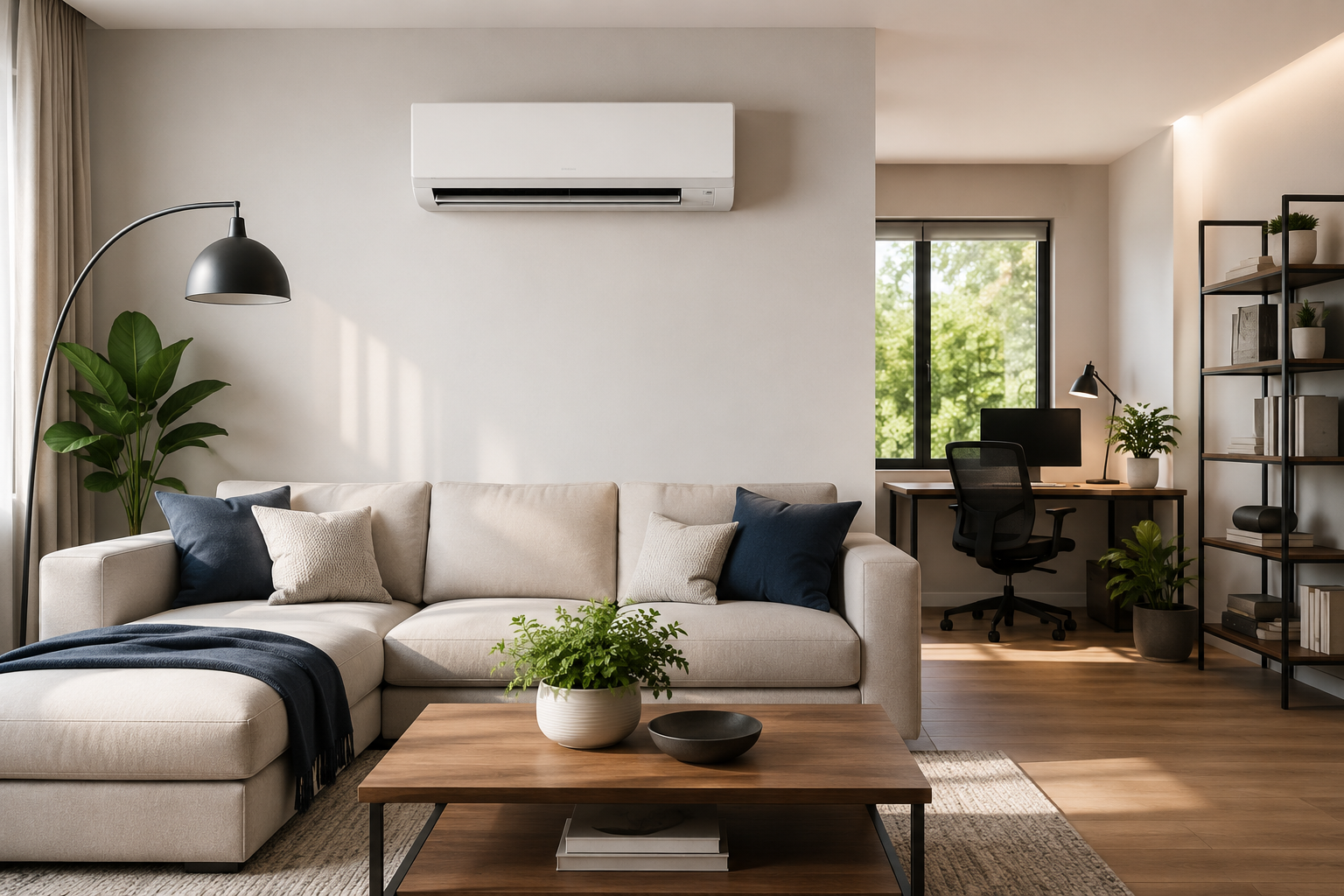
The Best Air Conditioning Systems for Bedrooms
When choosing air conditioning for a bedroom, comfort during the night is usually the main priority.
Unlike living areas, where some background noise often goes unnoticed, bedrooms require a quieter approach. Even a relatively small amount of fan noise can become distracting when you’re trying to sleep, which is why many homeowners prioritise low-noise systems over raw cooling power.
Modern wall-mounted split systems are often the preferred choice for bedrooms because they provide efficient cooling while operating quietly. Many models also include sleep settings that gradually adjust temperatures overnight, helping maintain comfort without unnecessary energy use.
Airflow direction is another important consideration. Cool air should circulate naturally throughout the room rather than blowing directly onto the bed. Proper positioning can make the room feel more comfortable while reducing the likelihood of cold spots or uneven temperatures.
Bedrooms also tend to have lower cooling demands than larger communal areas. As a result, a compact and efficient system is often sufficient to maintain a comfortable temperature throughout the year.
The Best Air Conditioning Systems for Living Rooms
Living rooms often present the greatest cooling challenge within a home.
These spaces tend to be larger, receive more sunlight and accommodate more people than other rooms. In open-plan properties, cooling demands can increase further as kitchens, dining areas and living spaces blend into one larger environment.
As a result, living rooms typically require systems capable of moving larger volumes of air while maintaining consistent temperatures across the entire space.
Wall-mounted split systems remain a popular option, but larger rooms may benefit from higher-capacity models or multi-split configurations. The goal is to achieve even cooling throughout the room rather than creating comfortable areas close to the unit while leaving other parts of the space noticeably warmer.
Large windows, vaulted ceilings and open-plan layouts can all influence cooling requirements. This is why living room air conditioning often benefits from a more detailed assessment rather than relying on simple room measurements alone.
When properly matched to the space, a modern air conditioning system can keep temperatures comfortable even during periods of sustained warm weather.
The Best Air Conditioning Systems for Home Offices
Home offices have become one of the most common locations for residential air conditioning installations.
Unlike bedrooms, these spaces are often occupied for long periods throughout the day. Computers, monitors, printers and other equipment generate heat continuously, while direct sunlight can quickly make a small office uncomfortable during summer months.
A good home office air conditioning system should provide consistent cooling without creating excessive background noise. This is particularly important for people who spend much of the day on video calls or carrying out focused work.
Modern split systems are often well suited to this environment because they can maintain stable temperatures while operating quietly. The result is a more comfortable workspace and fewer distractions throughout the day.
Energy efficiency is also an important consideration. Since many home office systems operate for several hours daily, small improvements in efficiency can have a noticeable impact on long-term running costs.
Split Systems vs Multi-Split Systems
When cooling multiple rooms, homeowners are often faced with a choice between a standard split system and a multi-split system.
A traditional split system consists of one indoor unit connected to one outdoor unit. This arrangement is often the simplest and most cost-effective solution when cooling a single room such as a bedroom or home office.
A multi-split system allows several indoor units to connect to a single outdoor unit. This can be particularly useful in homes where cooling is required across multiple bedrooms, living areas or workspaces.
The main advantage of a multi-split system is flexibility. Different rooms can often be controlled independently, allowing occupants to cool only the areas they are using. This can improve comfort while helping to reduce unnecessary energy consumption.
Many homeowners exploring cooling options also compare air conditioning systems with other forms of home climate control. It’s worth noting that many modern air conditioning systems use heat-pump technology to provide both cooling and heating. Depending on your property’s requirements, dedicated heat pumps may also be worth considering as part of a wider home heating and cooling strategy.
The right choice ultimately depends on the layout of the property, the number of rooms being cooled and how those spaces are used on a daily basis.
Energy Efficiency and Running Costs
For many homeowners, running costs are just as important as installation costs.
Modern air conditioning systems are considerably more efficient than many people expect, particularly when equipped with inverter technology. Rather than operating at full power and repeatedly switching on and off, inverter systems adjust their output to match demand and maintain a stable temperature.
This approach not only improves comfort but can also reduce energy consumption compared with older fixed-speed systems.
Running costs will vary depending on several factors, including insulation levels, thermostat settings, room orientation, electricity prices and daily usage patterns. A well-insulated bedroom may require relatively little energy to remain comfortable overnight, while a large living room exposed to direct sunlight may place greater demands on the system.
When comparing units, it is often worth looking beyond the purchase price and considering long-term efficiency. A more efficient system may cost slightly more upfront but can deliver lower operating costs over many years of use, particularly when used regularly throughout the year.
Features Worth Considering
Modern air conditioning systems offer a wide range of features, although some provide more practical benefits than others.
Smart controls have become increasingly popular because they allow homeowners to adjust temperatures remotely and create schedules that align with daily routines. This can improve comfort while avoiding unnecessary energy consumption when rooms are unoccupied.
Air filtration technology is another feature worth considering. Many systems include filters designed to capture dust, pollen and other airborne particles, helping improve indoor air quality.
Some premium models also offer occupancy sensors that automatically adjust output when rooms are empty, along with advanced airflow controls that help distribute cooled air more evenly throughout the space. While these features may not be essential for every household, they can improve comfort and convenience in day-to-day use.

Common Mistakes When Choosing an Air Conditioning System
Many air conditioning problems can be traced back to decisions made before the system is even installed.
One of the most common mistakes is choosing a unit based purely on price. While budget naturally plays a role, the cheapest option does not always represent the best value over the long term. A poorly matched system may struggle to maintain comfortable temperatures, consume more energy and wear out more quickly.
Another common issue is focusing exclusively on cooling capacity without considering how the room is used. Factors such as sunlight exposure, occupancy levels and heat generated by appliances can all influence performance.
Noise levels are also frequently overlooked. A system that performs well in terms of cooling may become frustrating if it produces excessive noise in a bedroom or home office environment.
Taking a broader view of comfort, efficiency and daily usage often leads to better outcomes than concentrating on a single specification.
Choosing the Right Air Conditioning System for Your Home
The best air conditioning system is not necessarily the most powerful or the most expensive. It is the one that matches the demands of the room in which it will be used.
Bedrooms generally benefit from quiet operation and steady overnight cooling. Living rooms often require greater airflow and cooling capacity, particularly in larger or open-plan spaces. Home offices sit somewhere in the middle, where comfort, efficiency and low noise levels all play an important role.
By considering the unique requirements of each room, homeowners can make a more informed decision and enjoy better comfort, lower running costs and more reliable performance over the long term.
If you’d like advice on selecting the most suitable system for your property in Brighton, Hove, Haywards Heath, Worthing or anywhere in the surrounding area feel free to contact our team for guidance.